When I graduated from the Academy of Art University, I had $80,000 of student debt and a portfolio that wasn't built for the job I wanted. I sent it out anyway and collected rejection letters, including one from Dreamworks. The portfolio didn't get fixed by drawing more. It got fixed when working artists sat down with me and told me, honestly, what was wrong with it. That's when I learned the lesson this whole article is built on: storyboarding is fast, clear visual communication under deadline, not pretty drawings. Here's how I train myself and my students for the actual job, building on the fundamental drawing skills every storyboard artist needs.
A good board artist makes decisions quickly. Their figures read at a glance. Their staging holds up when the camera cuts. Their rooms don't fall apart between panels. That skill comes from targeted, timed drills that fix one weak spot at a time, not from doodling aimlessly.
Do these six exercises in rotation, 20-30 minutes daily. No perfect schedule needed, just a repeatable one that moves the needle.
What counts as an exercise
A real drawing exercise:
- Takes 5-15 minutes
- Targets one specific skill gap
- Has a clear pass/fail check
- Gets repeated daily until the problem's fixed
What isn't an exercise:
- Mindless sketching with no goal
- Spending hours rendering one drawing
- Practicing skills you already have
I want to be blunt about this because it's the exact mistake I made out of school. I had hundreds of drawings and none of them targeted anything. I was good at drawing things I already knew how to draw, over and over, which feels productive and isn't. Storyboarding is problem-solving under time pressure. Your drills should mimic that, not dodge it. When I review portfolios now, I can tell within thirty seconds whether someone practiced with a goal or just practiced. The goal-less ones have a dozen pretty faces and zero rooms, zero staging, zero coverage. If you recognize yourself in that second list, read up on the bad habits that hold storyboard artists back.
The daily routine that works
Here's the structure I use, and the one I push every student toward. Stick to it every day, that's how you develop good drawing habits that last:
- 5 min warm-up - Loose marks to wake up your hand
- 15 min focus drill - Pick one weak spot, set a timer, attack it
- 5 min application - Use that skill in 3 quick thumbnails
- 2 min review - Circle your biggest mistake, write one fix for tomorrow
That's it. The magic happens in the constraints. I still wake up at 4am most days to get my most important art task done before family and work obligations crowd it out. I don't do that because I'm disciplined by nature. I do it because I learned the hard way that if the important drawing task waits until "later," later never comes. Put the thing that matters most first, before the day gets noisy.
One skill per week - don't jump drills daily. Stay on perspective for 7 days straight. Then gesture. Then staging. Depth beats breadth. Here's a simple four-week plan that covers the drills below:
- Week 1: line control. Dot to dot, ellipses, body mechanics, every day. Your goal by day 7 is a line that doesn't wobble when you commit to it.
- Week 2: gesture. Rounds A, B, and C daily. Your goal is a pose that reads in under two seconds and a verb you can write under it instantly.
- Week 3: perspective. Boxes, cylinders, the 1-minute room. Your goal is a room that survives a camera cut.
- Week 4: thumbnails and coverage. The 12-thumbnail drill, silhouette checks, the redraw challenge. Your goal is speed with options, not just speed.
Track four things only - date, time spent, drill name, one note. Any more and you're building spreadsheets instead of skills.
Tablet users: same rules apply. If your stabilization setting is doing the work, you're cheating yourself, and I say that as someone who had to break that habit myself.
Watch: Drawing Routine / Workspace Setup
Fix your lines first
Wobbly lines ruin everything else you do. A board supervisor doesn't consciously clock "weak line confidence" but they feel it. A shaky, over-scratched line reads as an unsure pose, and an unsure pose reads as unclear staging, even when the idea underneath is fine. Spend two minutes on these before any other drill:
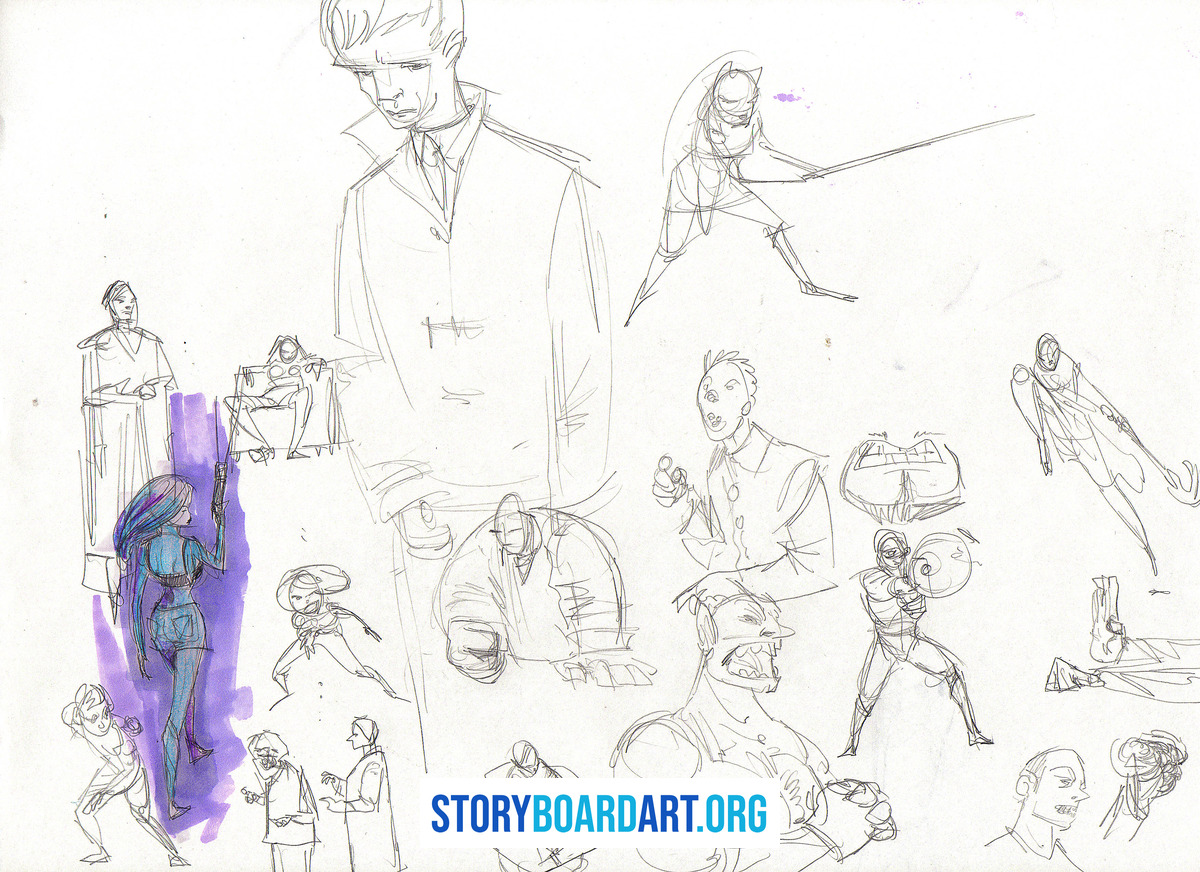
Dot to dot - Place two dots. Connect them in one stroke. No scratching. No do-overs. Fill a page with straight lines in all directions.
Ellipses - Heads, shoulders, wheels, camera moves, they're all ellipses. Draw them at every angle until they snap into place. A weak ellipse is why a character's head looks like it's glued on wrong, or why a car in a chase sequence looks like it's floating.
Body mechanics - Small lines come from the wrist. Medium lines from the elbow. Long lines from the shoulder. If a line wobbles, you're using the wrong joint. You'll know you're improving when you stop needing three attempts to lay down one clean diagonal.
Digital tip: Turn stabilization off for most warm-ups. Feel the difference when you turn it back on.
Gesture that actually works for boarding
Forget anatomy perfection. Boarding needs poses that read instantly, because an audience, and a supervisor, only get a glance. When gesture is weak, every panel looks like a held breath instead of a moment in motion. Here's how I train that:
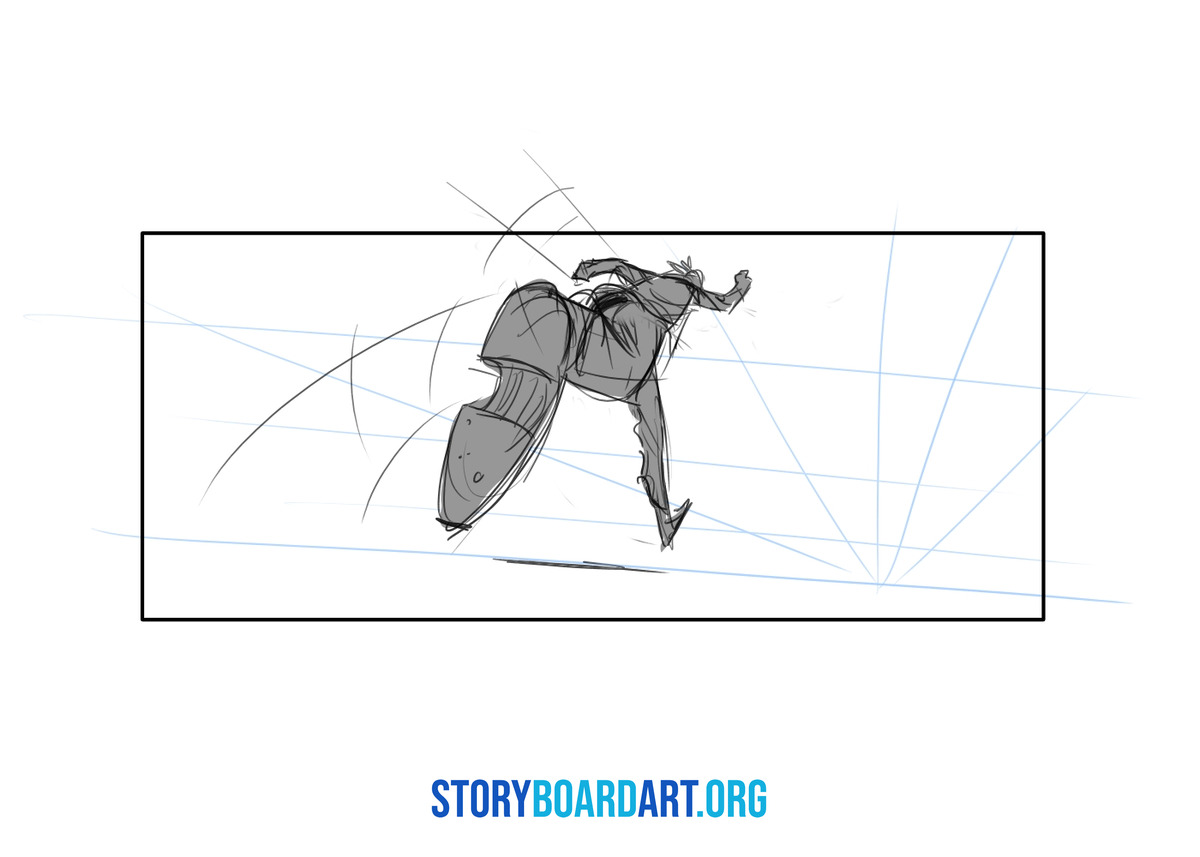
Round A (30 sec/pose) - One line for the action, sausages for limbs. No details. Speed forces you to find the one shape that matters.
Round B (1 min/pose) - Add one board-specific skill per pose:
- Weight on one foot
- Clear silhouette
- Hand doing something specific
Round C (2 min/pose) - Turn it into a usable mannequin: boxes for torso and pelvis, cylinders for limbs. This is the version that starts to look like something you could actually drop into a board.
After each pose, write one action verb underneath it. If you can't name it instantly, the pose isn't clear enough, full stop. I tell students that's the single fastest self-check in this whole list. You'll know you're improving when the verb comes to you before you've even finished the drawing.
Perspective that doesn't embarrass you
Most beginners hate rooms, so they avoid drawing them, so they stay bad at them. Then their boards fall apart the moment the camera cuts to a new angle and the furniture doesn't match. A story supervisor will catch that instantly, because continuity breaks are one of the first things they scan for. Fix it fast:
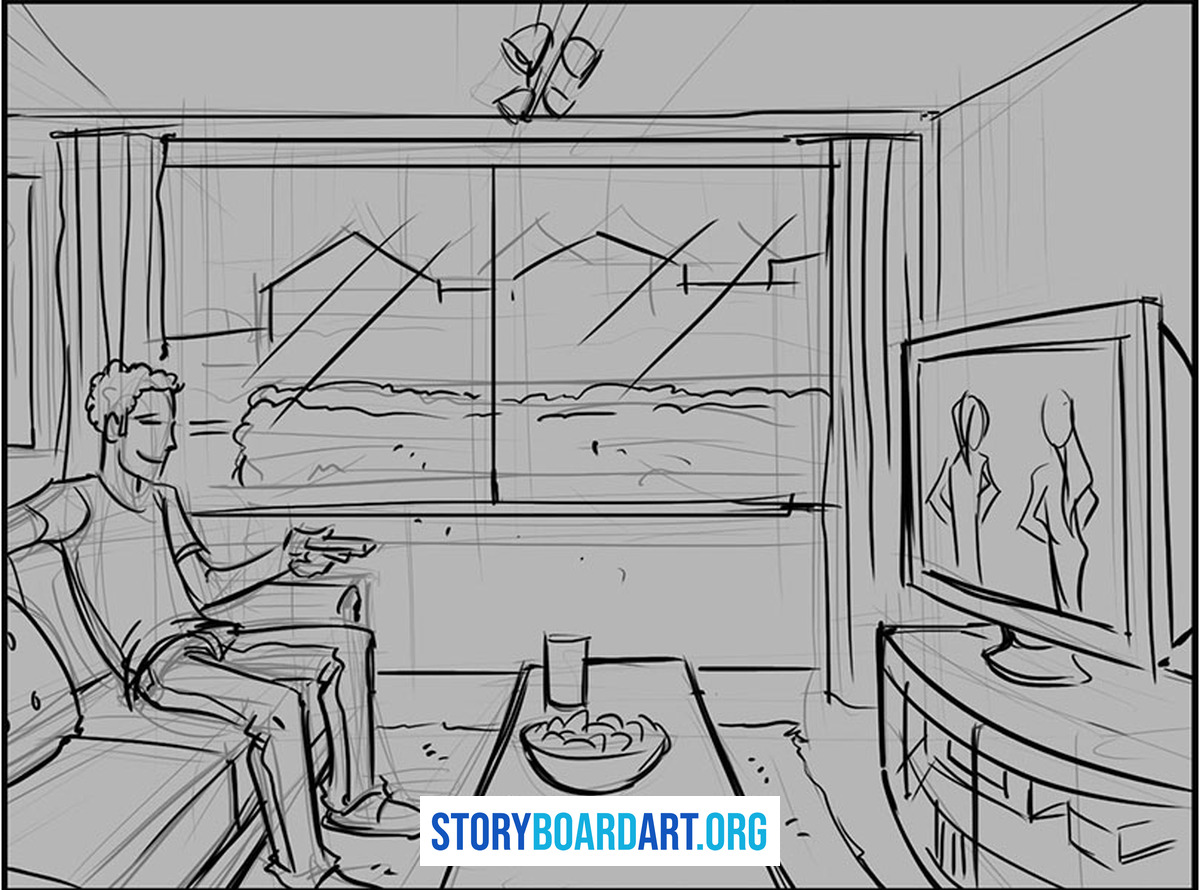
10 boxes - Two-point perspective only. Put some above eye level, some below, some at angles. Add one plane change per box, where wall meets roof, for example.
10 cylinders - Top and bottom ellipses must tilt the same way. If not, your cylinder looks broken, and so will every prop you build from one.
1-minute room - Two vanishing points, implied floor grid, 3 boxes as furniture. Time pressure forces you to place things decisively instead of second-guessing every wall.
The real test - Draw the same room from two camera angles. If the furniture jumps between shots, you've failed, and that's exactly the kind of failure a supervisor circles in red. You'll know you're improving when the second angle takes you less time than the first, because you're placing from understanding, not guessing.
Digital tip: Once a week, work with no undo button. Commitment breeds confidence.
Thumbnail like you mean it
Thumbnails are rough, fast, and disposable. Their only job is to generate options before you commit to a panel. Beginners skip this step and jump straight to a "final" drawing, which is exactly backwards: without options, you lock in the first idea, which is rarely the best one.
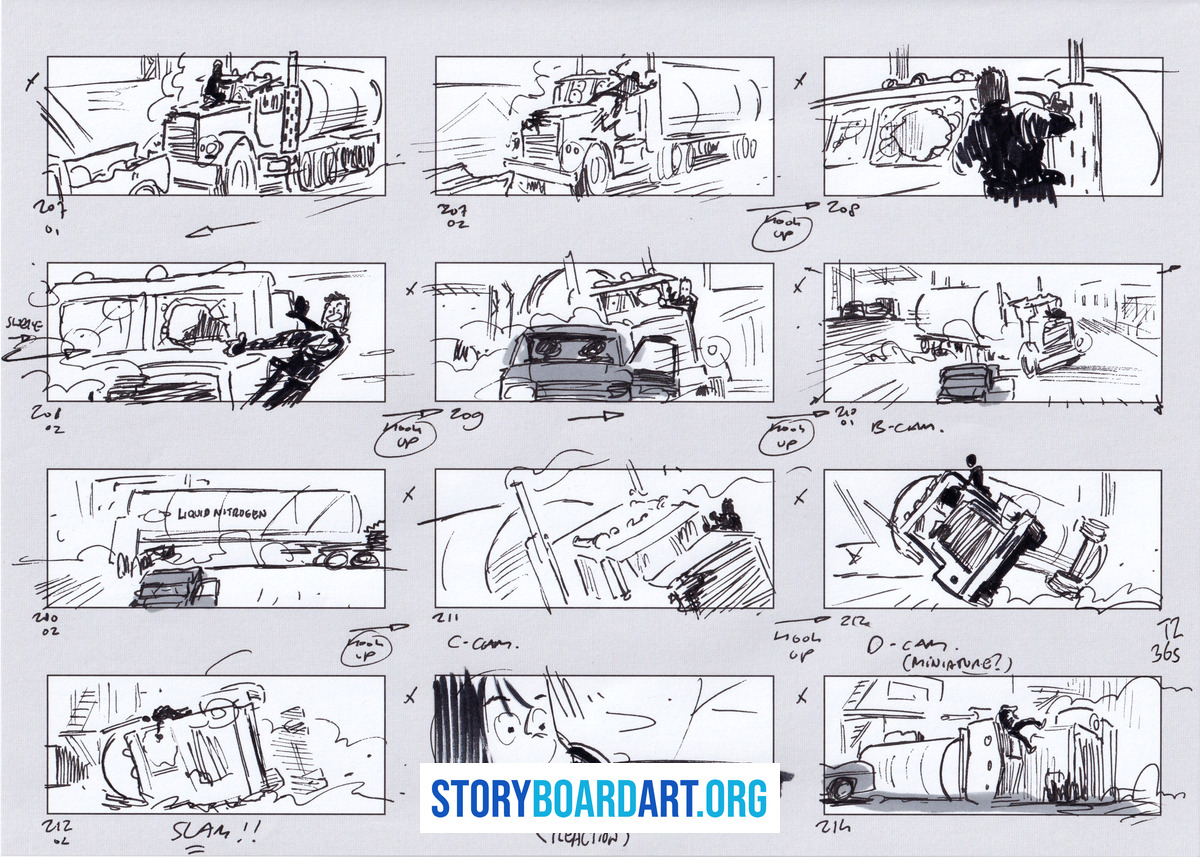
12 thumbnails, 1 min each - Same story beat, 4 wides, 4 mediums, 4 closes. Constraint creates variety, and variety is what gets you hired, because it shows a supervisor you can think in coverage, not just single images.
Silhouette check - Fill one thumbnail per row as solid black. Can you read the action? If not, simplify.
3-value reduction - Light, mid, dark. If the focal point gets lost, no rendering will save it later.
This trains the real review process. Supervisors scan pages in 2 seconds max. Make every panel earn that glance. You'll know you're improving when your first thumbnail stops being your only idea. For more ways to get faster, see how to speed up your drawing.
Steal from the pros
Pause films. Screenshot six stills from one scene. Study them like this:

- Thumbnail each still roughly
- Label W/M/C (wide/medium/close)
- Trace only the big shapes, no details
Then pick one still and draw three alternates, changing just one thing each time:
- Camera height
- Lens choice
- Staging
You'll quickly see why the director's choice worked better than yours, and that gap is the whole lesson. I didn't understand staging until I started doing this drill and noticed, again and again, that the professional choice was almost always simpler than mine, not more clever.
Digital tip: Two values only, light and dark. Multiply layer for values, line on top. Brutal clarity beats pretty rendering.
The redraw challenge
One panel. Ten attempts. No do-overs.
Pick a panel your portfolio needs right now, not a random one. Say, two people talking at a table. Now:
- First three: Solve the big read (shape, angle, horizon)
- Next four: Fix perspective and proportion
- Last three: Simplify and speed up
Keep the story beat identical across all ten. Only change the shot. That's coverage, the ability to generate usable alternatives fast, and it's the single skill I wish someone had drilled into me before I built my first portfolio. You'll know you're improving when attempt ten takes you half the time attempt one did, and still looks better.
FAQ
How soon will I see my drawing improve? Line control comes fast, usually within a few weeks. Solid perspective takes months. A little practice every day beats cramming for hours once a week.
Should I practice on paper or on an iPad? Pick one main tool and stick with it for 30 days. If you work on a tablet, train with stabilization turned off some of the time.
What should I do if I start to burn out? Attach your drills to scenes you actually care about. Stop when the timer dings, even if you're in the middle of a good run.
What if my wrist starts to hurt when I draw? Long strokes should come from your shoulder, not your wrist. If drawing hurts, something in your setup is wrong, so fix it before you keep going.
When should I start building my portfolio? Start now. These drills support your portfolio work, they're not a replacement for it.
The job is about solving visual problems fast under pressure. Train for that exact thing, and you'll pull ahead fast. I wish I'd known that at graduation instead of learning it through a stack of rejection letters. If you're just getting started, these storyboard beginner tips will help you find your footing.
